
Numeracy: an idea of a bygone age
We should be far more ambitious than the current concept of numeracy if our children are to thrive in an AI future.

I gave evidence at a House of Lords’ committee on numeracy last week. This got me thinking. And I increasingly think that our conception of numeracy is all wrong.
There is a reasonable chance that when people in 2100 look back on our debates about maths education today it will seem that we were fiddling whilst Rome burned. Something extraordinary may well be happening in the economy, which will filter through into the labour market and the rest of our lives. It is probably not an exaggeration to say that artificial intelligence will be akin to the spinning jenny, the high-pressure steam engine and iron puddling all arriving in the economy at once - the industrial revolution condensed into a decade. We do not know what this will mean for employment and livelihoods, but it cannot fail to have an impact.
There is every chance that we will see mass displacement of certain white collar job roles - those which have traditionally provided a comfortable living for hundreds of thousands of people. I expect these will be replaced in some way, but if the industrial revolution taught us anything it’s that progress can be extremely painful for those caught up in it. We have a duty to prepare people as best as possible for whatever transition may be coming.
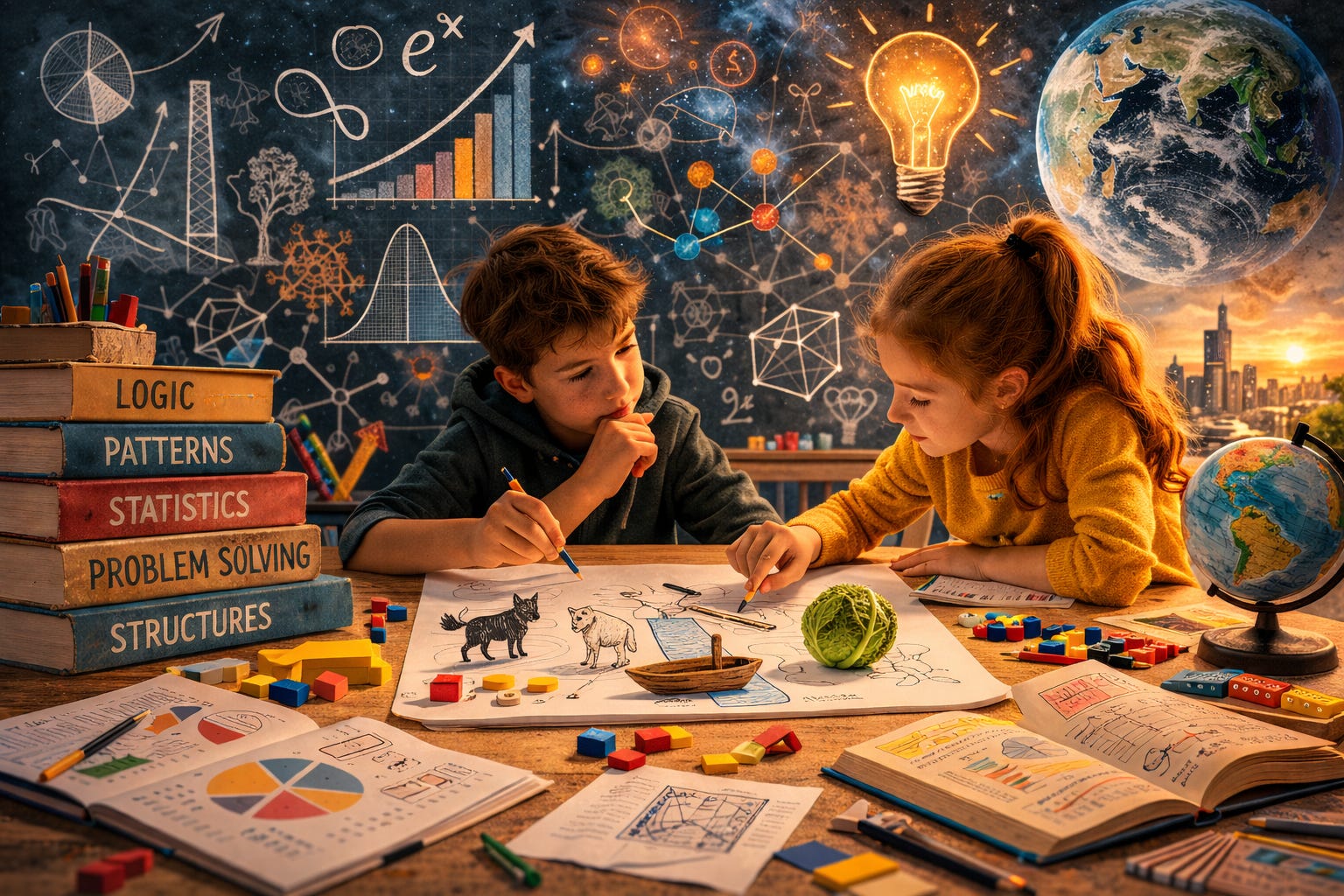
So what of numeracy? My contention is that numeracy is a concept of a bygone age. If numeracy means being able to calculate percentages or work out the cost of a holiday, it is ceasing to be a useful concept. Numeracy, as we conceive of it today, was designed for a world where a good living meant sitting at a desk using Microsoft Office for eight hours a day. Where calculating percentages in spreadsheets was sufficient for many jobs, and necessary for many real-life tasks.
That world is disappearing, and both of these conditions are ceasing to be true. If the jobs that depend on humans having this elementary level of numeracy disappear, and the real-life tasks that require it become more easily done by free artificial intelligence, then what is the point in numeracy at all?
Two new pillars of numeracy
I think that we should redefine numeracy around two pillars that are robust to the changing world. These are more ambitious than our current conception of numeracy, but we should be ambitious for our children.
The first pillar is mathematical intuition.
My argument above is that calculation is becoming redundant as a skill that is valuable in the labour market and in real life. But it is not an argument that learning to calculate is redundant. Learning to calculate is how you develop a deep sense of how numbers relate to one another - how quantities interact and compound. This deep sense of numbers and their interactions, being able to feel the relationship rather than calculate it, is what I think of as mathematical intuition. And it is essential.
The common argument I hear is that humans need to be able to do their own maths in order to verify AI outputs. To me, this is rubbish. Firstly, because there are plenty of far simpler ways of verifying an AI’s calculations. Secondly, because it is miserable and reductive way to conceive of human existence. We need mathematical intuition, to feel the relationships between quantities and variables, because we need in in order to think. Without this we cannot hold a model of the world in our own minds. And without such a model we cannot think for ourselves, instead outsourcing our thinking to an LLM.
This worries me immensely, not for any social or economic reason but because it eats away at our humanity. The inverse of Descartes’ conclusion is also true - when we cease to think, we cease to be.
What does raising the bar here look like in practice? It means our endpoint cannot be young people who, given time, can calculate a percentage increase. We need young people who can estimate one fast, who can sketch how two variables relate to each other, who have a sense of whether a change is likely to be statistically significant. It means the scope of what we call numeracy must include statistics and exponential change — not as advanced topics, but as essential ones.
Some people will think this is excessive, that these concepts are deeply unintuitive. But developing an intuition for the unintuitive is precisely what education is for. Turning the other cheek is unintuitive. Respecting minorities is unintuitive. Learning to read is unintuitive. The reason we have compulsory schooling is to teach the unintuitive things upon which a thriving society depends. Exponential change and statistical significance must fall into this category too.
The second pillar is mathematical problem solving. Eugene Wigner described the “unreasonable effectiveness of mathematics”: why, he asked, does the most abstract discipline turn out to be essential to the most practical? His answer is that mathematics deals with the deep structures of the universe, and those structures recur everywhere.
There was a lovely recent example of this written up in Quanta Magazine. There is a relatively niche field in mathematics that investigates aperiodic tiling - patterns that never repeat no matter how long they go on for. It is highly abstract and seems, whilst fun, of little real world utility. But a chance conversation on a train led two mathematicians to realise that the mathematics of aperiodic tiling is equivalent to the mathematics of quantum error correction - a major problem in quantum computing. And because aperiodic tiling has been around for longer, the mathematics in this field is ahead. The techniques and results from this seemingly irrelevant niche of mathematics turn out to unlock the next wave of computing breakthroughs.
Mathematics teaches us to reason from deep structures, to see to the heart of a problem rather than its surface. In theory there is problem solving in our schools, but in reality there is very little. It tends to appear as contrived word problems where people take advantage of bizarrely complicated special offer to purchase unreasonably large quantities of watermelons. These are not really problems, they’re calculation exercises in fancy dress.
I once took my son to a maths class at a Russian saturday school. The class were doing number bonds to 7. When I introduced myself to the teacher at the end her face dropped, turned ashy white. She said, in an embarrassed voice, that she was ashamed I saw her teaching arithmetic. I should come back next week when they would be doing real maths - logic.
There is plenty of problem solving a four year old can do. They can work through a problem like:
“A wolf, a goat and a cabbage need to cross a river. You have a small boat and can only take one across at a time. But if left alone, the wolf will eat the goat and the goat will eat the cabbage. How do you get them all across?”
As they get older they could try something like:
“Alice and Bob take turns removing either one or two stones from a pile of seventeen. The player who takes the last stone wins. Alice goes first. Who wins?”
What makes these questions worthwhile is not that they use bigger numbers or require more convoluted calculation. They require thought. They require you to model a situation, to reason through it, to test possibilities and start to generalise.
Thought is not what we prize in our mathematics classrooms. Not because rote learning crowds it out (you need rote-learned knowledge to think with), but simply because we do not expect it. Our expectations of what children are capable of are low, and they are trapped by the ceiling we place on them.
Maths is not the enemy
A previous session of the Lords committee heard that we should not be “tarnishing the really important stuff with the brush of the very high-end mathematical beautiful proof stuff”. There is a deep belief that maths and numeracy are somehow in tension, that exposing them to maths makes them less likely to become numerate. This belief is both wrong and harmful. We should get out the brush and paint away.
We would never, for example, accept this argument in English. Nobody argues that the path to a more literate population is to stop reading great stories in order to do more comprehension. We understand instinctively that exposure to brilliant literature is part of what makes children literate. Why do we tolerate this logic in maths?
I’ve written before about how our approach to school mathematics is often to assemble all the ingredients but fail to make the cake. Children lose interest not because of a lack of ingredients in the pile, but because they just want to get baking.
We expect children to grasp the power of a novel, the moral of a play, the beauty of poetry. We expect them to laugh with Puck, rage with Othello, cry with Juliet. Yet we deem the elegance of a mathematical proof beyond them. We deem it contrary to them acquiring basic skills. There is no reason for this - none - other than our own low expectations. And it is not fair to our children for these to hold them back.
Maybe numeracy is just...maths?
Our conception of numeracy is becoming rapidly out of date. It will shortly no longer be necessary for everyday life nor sufficient for earning a decent living. Some futurists would argue this means we should abandon human understanding of maths. I argue we should go further on it. Our conception of numeracy is wrong because it does not go far enough. It prizes calculation over thought, and in doing so sells our children short.
A new conception of numeracy would be more ambitious. It would be to give children a deep intuition for numbers and the relationships between them. It would be to have them explore the structures that show up throughout our world, and practise the techniques and behaviours that allow us to grapple with them. It would raise them to think for themselves, to think genuinely novel thoughts in a world overwhelmed with recycled ones. After all, that is what maths does. So maybe, instead of numeracy, we should just have a thing called maths.
Spot on.
I was out for a meal with my wife, daughter and two of my grandsons for Mothering Sunday yesterday. The rise in petrol prices over the past week came up (they don't waste any time do they?) and my wife told us all how much petrol cost when she started driving; 5 bob a gallon compared to 1.79 a litre now. None of them like sums so I did some rough mental arithmetic and told them it was about 40 times more expensive now. Shock all round so I pointed out that my grandsons (pretty much on minimum wage) probably earned more in a day than my wife did in a month back then. She told us what her first wage was and this confirmed it. So, relatively speaking, petrol cost her more. Youngest grandson followed through on this and we got onto inflation affecting different things in different ways, which is why my wife and her first husband could afford a house together in their twenties but that still looked like an impossibility for him. Sorry for the shaggy dog story but my point is that although my grandson didn't want to do the sums (possibly didn't think he could, I didn't press this) he really did want to reason about these things. Teach young people how to reason and give them tools to do the sums.
Great read. The problem is that unless the western education system changes how students are evaluated and marked, those thinkers will be punished. The current system focuses on narrowing the thought scope of problems in exams by teaching a very specific way of studying, prioritising memorising an answer over thinking through all possible solutions. The current grading system isn't scoring students on how deeply they can think about a problem, and as such, in order to progress in the corporate world, students aren't incentivised or trained to be thinkers and problem solvers. They are taught how to follow orders and be good workers. Until we fix how we evaluate, any curriculum reform is essentially decorative.
https://aninjusticemag.com/a-nation-of-workers-not-a-nation-of-thinkers-20caf6e692bd?gi=c4c648ae6b68